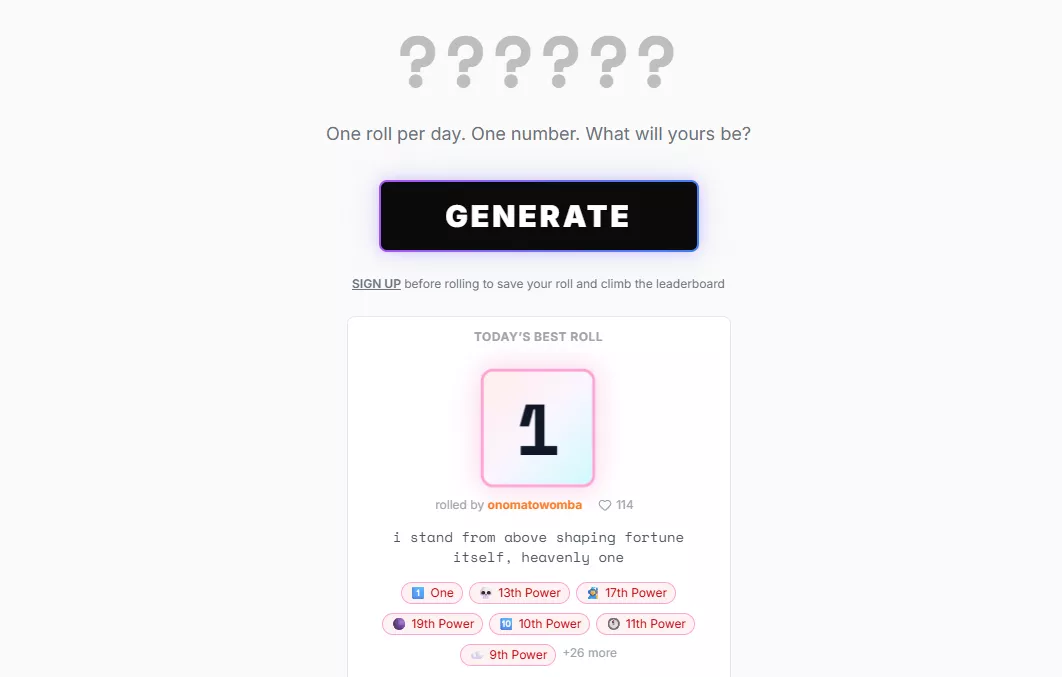
In a world drowning in Wordle clones, something truly unhinged has risen to the top. RNGdle—yes, that’s “RNG” as in random number generator—has gone from obscure browser experiment to the daily ritual everyone’s suddenly talking about. One click. One number between 0 and 1,000,000. Zero skill. Maximum chaos.
And somehow, that is exactly why it’s working.
The Hook Is Almost Insultingly Simple
Every day you get one roll. That’s it. No second chances, no clever starting words, no pattern recognition that rewards experience. You press the button, the universe hands you a six-digit (or fewer) number, and the game immediately judges it.
Is it a palindrome? Does it contain repeating digits? Is it prime? Does it hit a meme number like 69, 420, or 1337? Is it an absurdly clean sequence or some mathematical curiosity? The system scans for dozens of properties, hands out badges, and assigns Entropy Points (EP). Your roll then gets ranked on a rarity scale that runs from Trash all the way up to Mythic.
You don’t solve anything. You survive the roll. And then you share the screenshot.
Why This Hit So Hard, So Fast
1. It weaponizes pure luck in a skill-obsessed space
After years of daily games that quietly flex vocabulary, geography knowledge, or math fluency, RNGdle levels the field completely. A complete novice and a lifelong puzzle nerd have identical odds. When someone posts a Mythic roll with a ridiculous badge combination, the reaction isn’t “nice solve”—it’s pure envy mixed with laughter. That emotional range is rocket fuel for sharing.
2. The results are ridiculously shareable
The post-roll screen is built for social media. Color-coded rarity tiers, emoji-laden badges, massive EP numbers, and a clean “Top X%” ranking travel extremely well on X, Discord, and group chats. A single absurd roll (think six identical digits or a perfect meme number) can spark dozens of quote-tweets. The game essentially generates its own marketing every morning.
3. It satirizes the entire “-dle” explosion
By 2026 the daily-game landscape had become absurdly crowded. RNGdle feels like the logical endpoint—and the punchline. Boing Boing captured the mood perfectly when it called the game the moment Wordle clones “reached their apex.” Players get the daily ritual and the bragging rights without any of the cognitive load. That self-aware emptiness is strangely refreshing.
4. Collection and streaks still scratch the itch
Even though individual rolls are pure chance, the long-term loop is classic. Players chase rare badges, build collections, maintain streaks, and check leaderboards. The knowledge that a Mythic roll is theoretically possible every single day keeps people coming back, just in case today is the day the probability gods smile.
5. Friction is almost non-existent
No tutorial required. No account needed to play (though signing in saves history and unlocks leaderboards). The entire experience can be over in under ten seconds. In an attention economy that punishes anything demanding, RNGdle is ruthlessly efficient.
The Bigger Picture
RNGdle succeeds because it understands something fundamental about why people kept playing Wordle long after the novelty wore off: the daily shared experience and the ability to casually compete with friends. It simply removed the part that required actual effort.
Whether this is the peak of the daily-game trend or just another weird spike remains to be seen. But right now, thousands of people are waking up, pressing one button, and immediately texting their group chat the digital equivalent of “look what the universe just did to me.”
And honestly? That’s a pretty compelling reason to keep rolling.