What is HEFT?
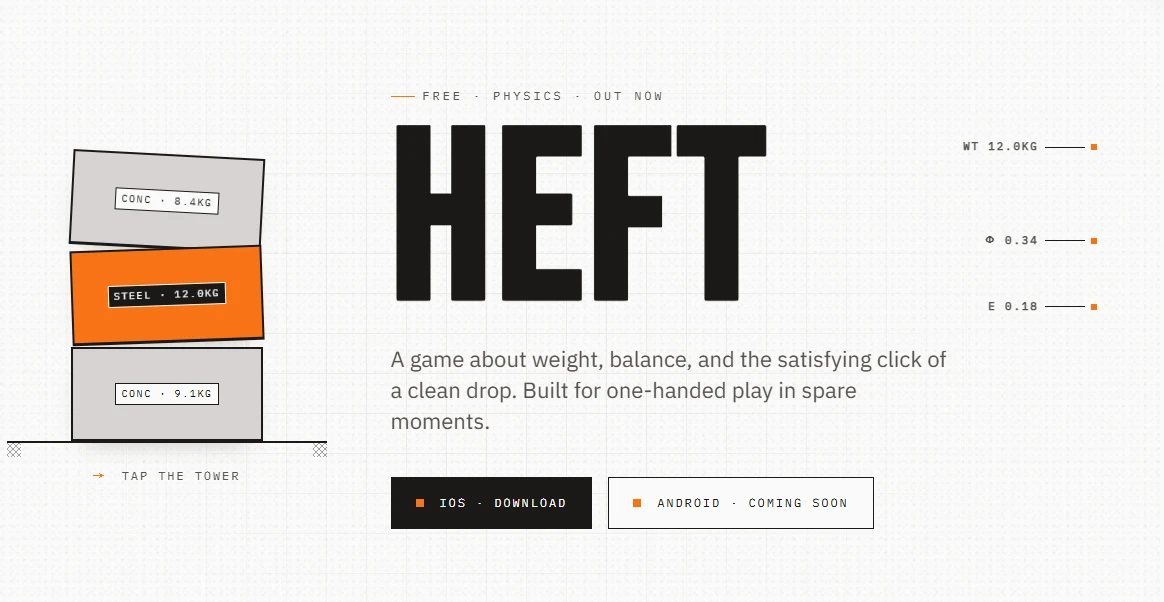
HEFT is a free physics-based tower-stacking game for iOS (Android coming soon). A block drifts across the top of the screen; one tap drops it. Box2D simulates real weight, friction, and balance so each landing feels solid or the tower leans toward collapse. Ten materials unlock by height, seven modes plus thirty missions and a daily challenge give reasons to keep building.
How to play HEFT
- Watch the block move horizontally at the top of the screen.
- Tap once to release it onto the tower below.
- Observe how the material’s mass, friction, and bounce affect the stack.
- Continue stacking while the tower remains stable; use the engineer’s toolkit (ballast, mortar, keystones) if it starts to lean.
- Choose a mode: Endless for open height, Ascent for segmented roguelike climbs, Time Attack for speed, Hardcore for single-mistake runs, Blueprint to fill silhouettes, Cascade for physics line-clears, or Zen for no-fail play.
- After a collapse, optionally demolish the tower from the base or continue from the last welded foundation line.
Materials and height progression
Materials enter the rotation as altitude increases. Concrete starts at ground level, steel appears around 5 m, wood at 12 m, rubber at 20 m, glass at 30 m, ice at 42 m, stone at 55 m, foam at 70 m, gold at 85 m, and obsidian at 100 m. Each has distinct density, friction, and restitution values that change how it sits, slides, or breaks. Gold multiplies score; glass multiplies it by 1.5 and can shatter.
A lifetime odometer tracks total blocks stacked across all runs. Height landmarks range from a two-storey house at 6 m through the Eiffel Tower, Burj Khalifa, Mount Everest, and finally the Kármán line at 100 km. A translucent ghost of the player’s best tower appears from the second run onward; crossing its peak triggers a new-record notification.
Core systems and tools
Every ten metres the tower welds into permanent foundation that cannot collapse below that line. The first continue each run is free. An X-ray view reveals force chains, load distribution, and the centre-of-mass plumb line. Wind, tremors, and a swinging wrecking ball can appear as hazards. Clean consecutive drops build a flow multiplier. After a run ends, a plunger detonates the structure material by material; landing the wreckage on its own footprint awards a clean implosion.
Availability and design notes
All modes, materials, and the thirty hand-tuned missions unlock through play. Occasional interstitial ads appear between runs; one optional purchase removes them. Nothing else is locked behind payment. The game is tuned for one-handed use in short sessions, uses native haptics, and includes original music that shuffles across runs.