What is Little Plot?
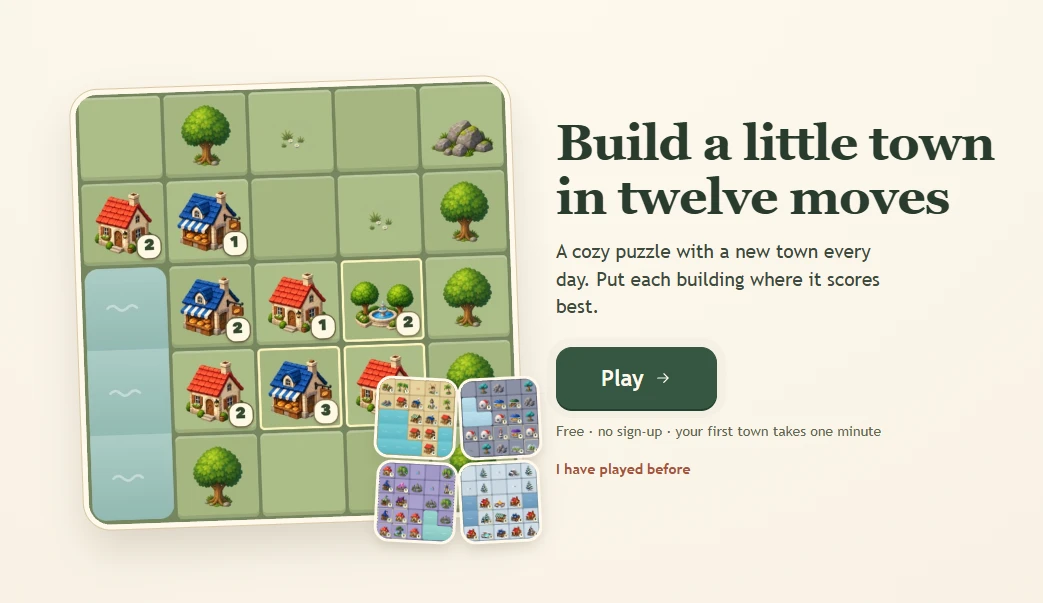
Little Plot is a free browser-based daily puzzle game. Players place twelve buildings in fixed order on a 5×5 map to form a small town, scoring points from neighbouring tiles. A new identical puzzle appears each day for everyone.
How to play Little Plot
- Examine the full queue of twelve buildings before placing anything. The order never changes and every building is visible from the start.
- Place the first building on any empty square. Each later building must share an edge with at least one already-placed building so the town remains connected.
- Score is calculated only from orthogonal neighbours (above, below, left, right). Diagonal tiles do not count.
- Water and rock tiles cannot be built on. They remain fixed and alter the value of buildings placed beside them.
- After all twelve placements the game awards up to three stars: one for reaching the daily target score, two for approaching the known best score, and three for matching that best score exactly.
- Unlimited free undo is available at any moment. Place a building, inspect the running score, and reverse the move if a better square exists.
- The daily puzzle is the same for every player. Scores can be compared on the public leaderboard or inside private clubs. A short practice town is also offered for learning the rules without affecting the daily result.
Building scores and placement priorities
Each building type has its own scoring rule. Houses form the foundation of most high scores because several other buildings gain points from them. A house scores 1 point, or 2 if it sits beside water. A bakery scores 1 for every adjacent house. A park scores 1 per adjacent house but loses 1 for every adjacent bakery or market. A market scores 2 for every adjacent bakery and loses 2 for every other adjacent market. A garden scores 2 when next to a park plus 1 for each adjacent rock. A well adds 1 point to every house that touches it. An inn scores 1 for each different building type among its neighbours. A mill scores 2 for every empty square that still touches it at the end of the puzzle. A church scores 1 for every house that shares its row or its column, regardless of distance.
Because the queue is known in advance, the strongest towns usually reserve clusters of houses for the buildings that reward them most. Parks and bakeries both want houses yet conflict with each other; separating the residential clusters from the commercial ones prevents the park penalty. Wells function like bakeries in placement terms: they belong in the middle of houses. Mills prefer the outer edge of the town so they retain empty neighbours. Churches reward linear arrangements of houses along a single row and column that cross at the church’s square. Water edges and rock clusters supply free bonuses that are hard to match in the centre of the map.
Tips for higher scores
Read the entire queue before the first placement. A park that appears late is worth little until its surrounding houses are already planned. Place high-value scorers only after their supporting houses exist, or leave deliberate gaps for them. Keep shops away from parks; two modest clusters usually outscore one crowded centre. Use the fixed water and rock tiles deliberately rather than treating them as obstacles. Because undo carries no cost, test every plausible square for the final two or three buildings; the last points are almost always found by trial rather than first intuition.
The same core rules apply across the optional Journey mode and its twelve worlds. Each world changes only one constraint (for example, requiring every new building to touch the previous one, or allowing stacking, or joining opposite map edges). Mastery of the base scoring interactions therefore transfers directly. Progress is stored locally in the browser; no account is required for the daily puzzle or the free portion of Journey.