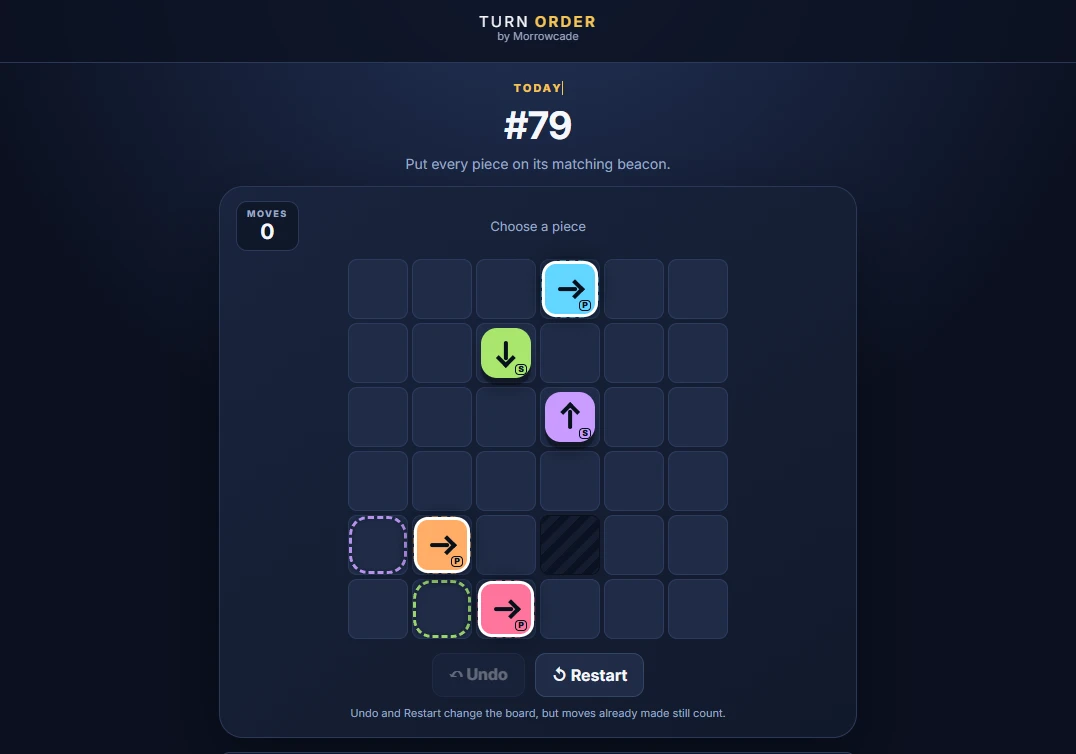
What is Turn Order?
Turn Order is a daily logic puzzle from Morrowcade. The board holds colored pieces, each marked with a direction and typed as either a Slider or a Pusher. Matching beacons appear as dashed outlines of the same colors. The single objective is to land every piece on its own matching beacon.
How to play Turn Order
- Tap any piece to activate it. Activation is the only player action; the piece then follows its own movement rule automatically.
- A Slider travels in its current direction until it hits another piece, a blocked square, or the edge of the board. Once blocked, it reverses direction and stops.
- A Pusher moves exactly one square in its current direction. If another piece occupies that square, the Pusher pushes it one square farther in the same direction. After the step or push, the Pusher itself turns around.
- Continue activating pieces in any sequence until every piece rests on the beacon that matches its color.
- Undo and Restart alter the current board state but never subtract from the recorded move total. The final score is the cumulative number of activations performed.
Order changes everything
The sequence in which pieces are activated is the central puzzle. A piece already sitting on its beacon may still need to leave that square so it can serve as a temporary blocker or free a path for another piece. Likewise, a piece may be required to occupy a non-beacon square long enough to stop a Slider or to be pushed into position by a Pusher. Because each activation is irreversible in the move count, the correct order must be discovered rather than brute-forced.
Sliders and Pushers interact differently with the same obstacles. A Slider will travel the full open distance and reverse only when stopped; a Pusher always advances a single square and can deliberately displace another piece. These contrasting behaviors make the same board state produce different outcomes depending on which piece is chosen next.
Blocked squares (shown with diagonal stripes) cannot be entered. Pieces may push or slide against them, but the blocked cell itself remains empty. Beacons function only as targets; they do not prevent movement or serve as walls.
Tips for solving
Count every activation. Because Undo and Restart leave the move total unchanged, experimenting still costs moves. Plan a short sequence mentally before committing the first tap.
Observe the current directions. After each activation a piece reverses, so the next time it is chosen it will travel the opposite way. Keeping track of facing is as important as tracking position.
Treat temporary occupancy as a resource. A piece that has already reached its beacon can still be useful as a moving wall or as a payload for a Pusher. Removing it too early can open an unwanted path; leaving it too late can block a required slide.
Use the archive for practice. Earlier daily boards remain available. Results on archived puzzles stay private and do not affect the statistics of the original day. Progress for both the current and past puzzles is stored in the browser, so returning on the same device preserves status.
After a solution is found, the page offers the optimal move count and a replay of that shortest sequence. Comparing the personal total against the optimum supplies a clear measure of efficiency without requiring external tools.