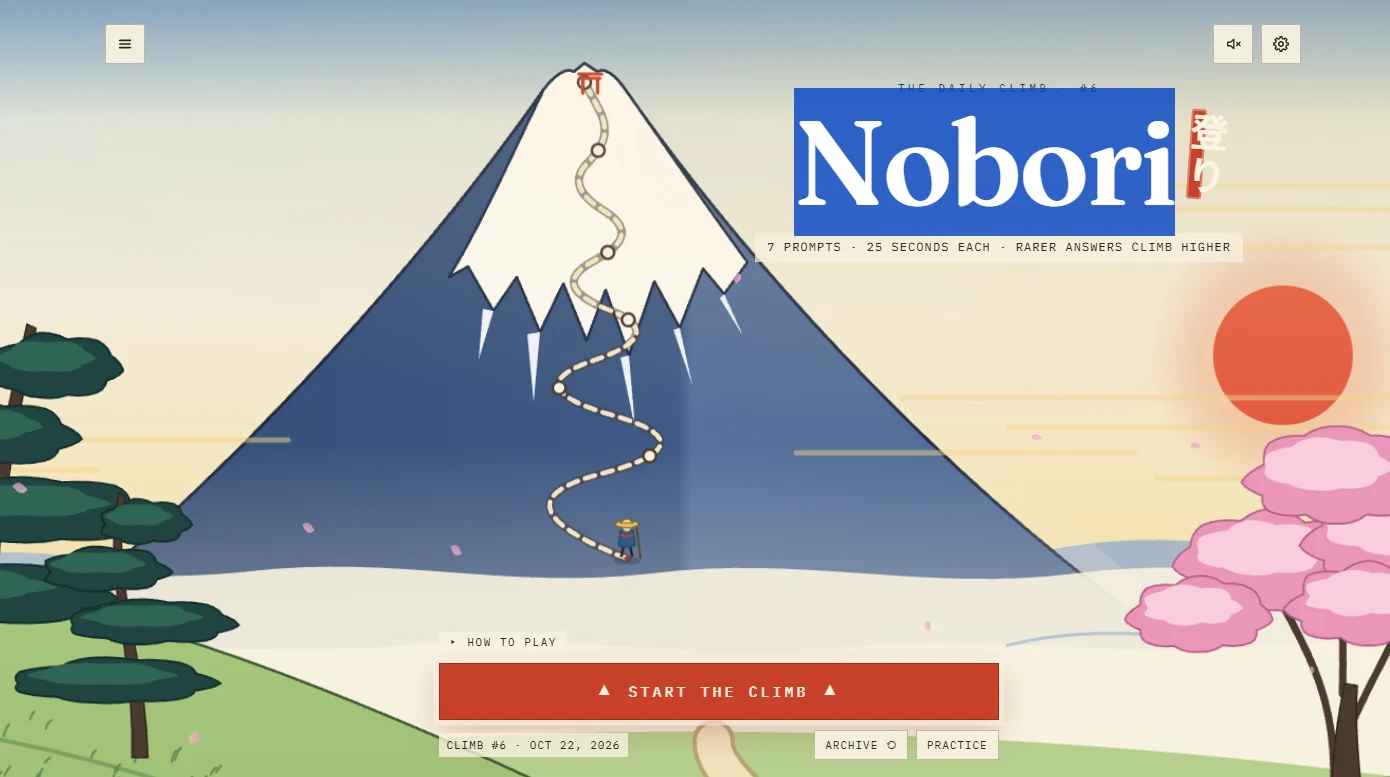
What is Nobori?
Daily trivia where the rarest answer climbs highest: 7 prompts a day, 25 seconds each, and rare answers climb toward Mount Fuji's 3,776 m summit. Free, no account, no AI. Daily mode, archive and unlimited practice; English and Portuguese.
How to play Nobori
- Open the daily climb page and select Start the Climb or Practice.
- Read the prompt that appears for the current round.
- Type an answer that fits the prompt before the twenty-five-second timer ends.
- Submit the answer; the system records its rarity relative to other players’ responses for that same prompt.
- Advance through all seven prompts in sequence.
- After the final prompt, review the total climb height, the rarity ranking of each answer, and the random share ID if you choose to post results.
- Use Archive to revisit earlier daily climbs or Practice to run unrestricted sets without affecting the daily score.
Scoring by rarity
Each prompt is independent. The score for an answer depends on how uncommon it is among all responses collected for that prompt on the same day. Common answers keep the climb low; uncommon but still valid answers push the marker higher on the illustrated path. Validity is determined by the game’s matching logic; empty or nonsensical entries receive no credit. The final height reflects the combined rarity of the seven answers rather than speed alone, although the timer forces a quick decision.
The mountain graphic updates after each submission so the player can see progress in real time. Because the daily set is the same for every participant, later players can still obtain high scores by choosing rarer valid responses. Practice mode uses different prompts and does not contribute to the shared daily ranking.
Tips for higher climbs
Keep answers specific enough to reduce overlap with the most frequent replies, yet still clearly related to the prompt. Overly broad terms tend to be chosen by many players and therefore rank lower. If the timer is nearly exhausted, submit a solid answer rather than risking an empty field. Results remain stored only in the local browser; there is no account system. Sharing uses a random ID that never includes a personal name. Returning to the same browser preserves local history of past climbs and practice runs.