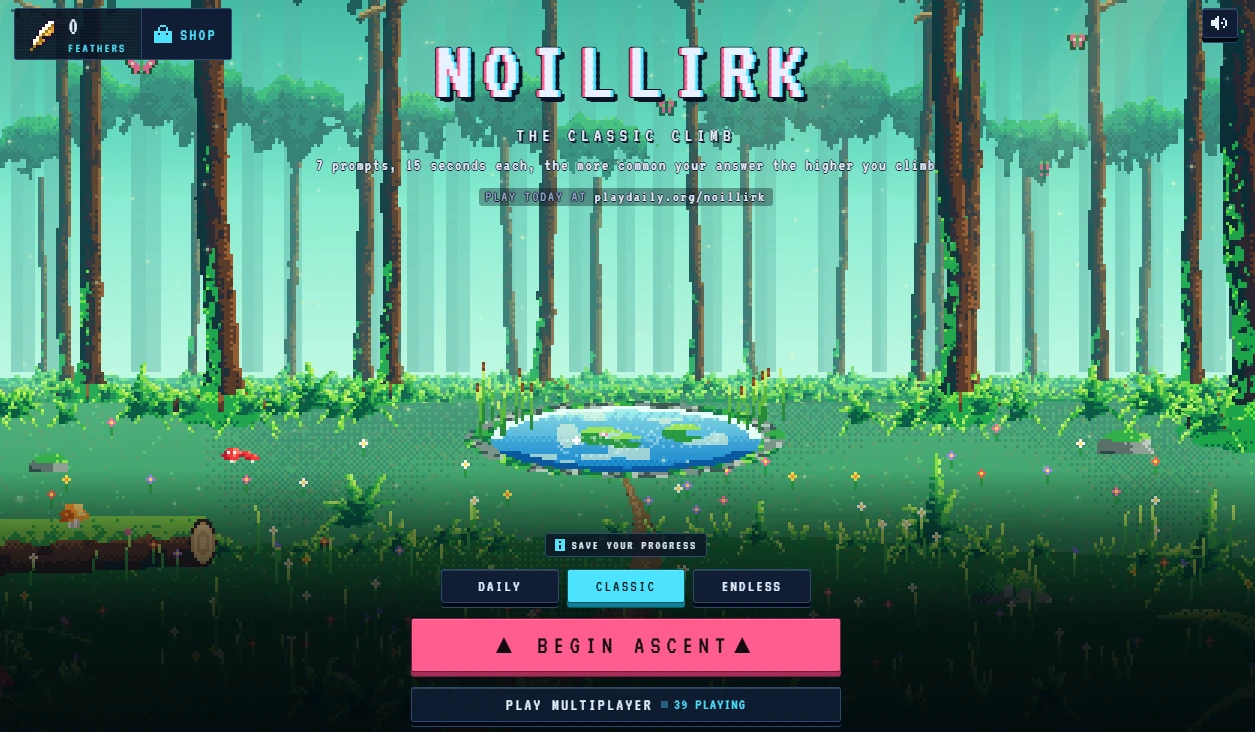
What is Noillirk?
Noillirk is a free browser survey game in which you read an open prompt and type the answer you believe most people would give. Points convert directly into altitude, so stronger matches to the crowd lift you higher from a forest pond toward the edge of space. A standard climb consists of seven prompts; Endless mode continues until balloons are lost.
How to play Noillirk
- A single survey prompt appears, such as “Name something people lose all the time.” You have 15 seconds to type one answer.
- The game ranks every accepted answer against a board of the nine most common responses. Only the number-one answer earns the maximum score.
- Points raise your altitude through six tiers: Grounded (4), Treetop (8), Kite (16), Cloud Nine (32), Jet Stream (64) and Sky High (100). A perfect 700-point climb reaches 14 km.
- Answers that do not fit the prompt are rejected with no further penalty beyond the time spent typing them.
- In Endless mode you begin with three balloons. A miss (timeout or pass) pops one; any accepted answer keeps the balloons, and a Sky High answer restores a popped balloon. There is no daily limit and no account required.
- Multiplayer rooms seat up to 30 players who face the same prompt and clock, then compare scores side by side.
Scoring and height
Only answers that land on the board of nine can reach the higher tiers. Places 2–4 score Jet Stream, places 5–9 score Cloud Nine, and anything outside the board falls lower according to how many people would still give it. The classic climb ends in the real jet-stream layer of the atmosphere; Endless mode continues through the Moon, the planets, the Sun, nearby stars, the galactic centre, the edge of the observable universe and beyond into 69 total zones, each corresponding to a measured or conceptual distance.
Tips for finding the top answer
Answer for the crowd rather than for yourself. Prefer the broad, everyday word over a specific variant—keys instead of car keys, pizza instead of pepperoni pizza—because the general term collects every related response. List the first three answers that come to mind, then picture a hundred ordinary strangers and choose the one most of them would say. When two options feel equally common, favour the one a child or grandparent would name first. Clever or personal answers almost always score lowest. A timely common answer always beats a perfect answer given after the clock expires.